Tara:
Breakfast has sure been tasty so far... Chapter 3 is all about traveling to work and I should qualify my email with traveling anywhere that takes you from home sweet home out into the world and then back again. The story of Martin Guerre fascinates me but I've been jaded by Broadway making every story in the universe into a musical. I am still trying to get the overly trite lyrics from the Martin Guerre musical out of my head that Rob played maniacally when it came out around ten years ago. Unfortunately for me (and you) the words of the title song made a permanent residence in my memory. (Look I'm Martin Guerre! There's no disguise, look in my eyes, I'm him I swear! And there's more... Look! I'm Martin Guerre! Broken and torn, I was reborn, out of despair!) The real story, though, is a doozy of a philosophical thinker "of a sixteenth-century French peasant who goes off to work in the fields one morning and doesn't come back. Time passes, and six years later he-or someone claiming to be him-returns, to take up again with his wife." The villagers compare the Martin they remember with the current man claiming to be him and they're not quite sure it really is him. How do we KNOW that the person we know and love that left for work is the same person who comes home at the end of the day? I know it's Rob who comes home because when the door opens I listen for a whistle and when I hear the chirp there he is, in green scrubs traipsing into the living room. But what if he didn't come home for six years and then came in the door one day in green scrubs with his old standard whistle? I know I wouldn't be sure it was him, even with the whistle because he'd been away so long. But what if you're sure it's the same DNA but the personality is startlingly different? Since I've been using Rob as my example I'll just make him the star and share my own Martin Guerre experience. In the summer of 2000 when Rob started his highly demanding and sanity taxing 2nd year of residency the kids and I went to Provo for six weeks and when I returned I really did wonder who this alien was in Rob's body. The Rob I encountered was not the same person I left six weeks before. In place of the happy, involved and social father and husband was a cranky, exhausted and glassy-eyed robot from the deep, murky pit of a maternity ward. I knew it was Rob because he still was semi-interested in Broadway musicals and golf but he didn't talk or laugh very often and his eyes had lost their sparkle. He didn't even want to tiglet Jonny who was one year old and, as you all know, highly tigletable. It was still the same genetic soup I kissed goodbye six weeks earlier but the personality I came home to was completely and permanently different. He truly was a different person from the experience of 2nd year residency. Smith says, "All of this means that if you do arrive at work as the same person who left your house, it's somewhat a matter of chance" just as one person's personality and life experience that walks out your front door is never the same that walks back in at the end of the day or the end of six weeks. Time changes everyone. The story of Martin Guerre is unique in that they weren't sure it was actually him but every one of us who leaves on a journey to anywhere "harbors the possibility of being blown off course...no matter what maps we use."
Annie:
Tara, I loved your review! Very fitting that Ch. 3 was yours, as you had some experience with Martin Guerre. I had never heard the story, but very interesting. Thanks for sharing about Rob, to not want to tiget Jonny is insane and I might have demanded a DNA test! I loved the last line - everyone who on a journey to anywhere "harbors the possibility of being blown off course...no matter what maps we use." Very thought provoking, because it could mean emotionally - depressed, work was horrible, physically - car accident to or from work, or any number of things.
Ideally we all come home from a trip or day of work better off than when we left. Maybe by being aware and thinking of it I can come home from a bad day at work and not let my negative energy take over. Great ideas, Tara.
Kristin:
Agreed! I loved your response Tara. I hadn't heard about the Martin Guerre story either but found it really interesting and the play on his name also ironic. My response from the chapter is the issue of the crowd phenomenon. Yes, when commuting to work I feel like the crowd at its worst as we "revert to the lowest common denominator". I don't like borrowing my roommates car for the mere fact that I can't stand the drivers and the rat race. I digress and exhibit some road rage and shaken fists. Anyway, from the experience I encountered at the Triathlon yesterday as kind of changed my perspective on things regarding crowd mentality. No where is it more apparent than in a race, i.e. the triathlon that each individual is competing for this common goal (kind of like going to work). But since life is full of paradoxes, why is it that in races one encounters so much encouragement and motivation from fellow runners/swimmers and cyclists? My roommates and I talked about it for a while yesterday: the phenomenon that encouragement, motivation and camaraderie exist in an environment where individuals should be competing against each other. I think it's largely because all of us realize the training and heartache gone into training and that the competition is really against oneself and not each other. For this reason, I love the common purpose and becoming "more than the sum of its parts" in crowds, particularly the one I found at the traithlon. There's more I could say on this but I'll stop. I also like the piece on showing up. I have a hard time with wanting to show up but I feel better every time I make the effort to not call in sick.
Dad:
Tara, this is a very impressive piece of writing that I didn’t know you had in you. It’s tightly constructed, painfully personal, and striking in its comparisons to Martin Guerre, a real tour de force of what appears to be a spontaneous outpouring of deeply connected thoughts and feelings, all traits that make for memorable writing and compelling reading. Its painful application to your personal life (the “completely and permanently different” Rob you discovered after the six-week hiatus) is a sobering commentary on your significant discovery that “Time changes everyone.” The questions that gnaw at me as I contemplate this inescapable truth is: Will the change be for good or ill? What makes the difference? And do the negative effects have to be permanent? Does the person whose changes seem so evident to the loved one realize that the light went out?
In retrospect, I wonder if my two years of agony trying to finish my dissertation after beginning a full teaching load at BYU in the fall of 1970 killed something in me. Did a light inside me go out permanently? I remember feeling more serene and laid back about life before that marathon nightmare of perpetual work, returning to the office from 7-12 each night to research and write after teaching all new classes during the day. I remember being furious that my graduate studies hadn’t prepared me for the reality of teaching large sections of basic humanities classes, where many of the topics were as new to me as they were to the students. It proved to be a real trial by fire that almost burned me out before I got started. But the most deleterious effect was a subtle, unwitting shift in my priorities that has produced negative consequences in the lives of those I love the most: my wife and children. I won’t go into my past regrets for too often choosing career over family in my daily priorities, but that trial created permanent consequences that I’m now attempting to rectify and will continue to work on for the
rest of my life. The good news is that progress is being made, slowly but surely. Prayer and fasting have helped immensely. Your revelations sparked resolutions in my own life. Thanks.
I wish I had simple answers to the weighty questions posed above. The profound truth that we are altered by the unexpected traumas and trials of daily life is much like a strong cross wind that blows an artillery shell slightly off course in the trajectory to its assigned target (I’m borrowing from your apt metaphor). One click of difference in the azimuth at the source equals a huge difference at the other end. So it is with our lives. Nothing is insignificant in the tests we face, yet nothing that attempts to deflect us from our eternal course can permanently alter our reaching the target if we let Him into the equation. This hopeful truth, made real by the Savior’s limitless love, was powerfully reinforced by my recent re-reading of George Ritchie’s book, Return from Tomorrow, about his near death experience during WWII. Dr. Ritchie’s life was permanently altered for the better by his brief exposure to the Savior’s light and love, the only power that can permanently eliminate the darkness of this life.
The Prophet Joseph endured more cross winds than anyone I know of except Jesus and look what it made of him. Without continual adversity, Joseph would have remained a simple farmer from upstate New York, but not the mighty prophet of the Restoration he eventually became. We know something Robert Smith probably has never even thought of, that we all have the potential to make permanent the good changes that are forged by our most painful experiences. We don’t have to be “blown off course” if we hold tight to the iron rod (the word of God). With His help, “Time changes everyone” for the better.
This will be a place for the Green family to conversate (convo) about the books we are reading together since we don't always have the time to get together in person. Now, because of the wonderful internet and technology we can do this no matter where we may be in the world. When your thoughts and words are being typed on a screen and sent out to the wide world web, you put a little more thought into it. So hopefully this will enhance our minds, and relationships.
The only good is knowledge and the only evil is ignorance.
Friday, August 5, 2011
Chapter 2 "Getting Ready"
Kristin:
Smith mentions this process as "collecting yourself both to experience and not to experience the day ahead" (16). I found this to be so true for me and my year of growing pains. I would wake and get ready with the idea that I'm going to be an offensive player, no matter what (I would classify this as wanting to experience the day). Then, there are days when I wake up and think, "ok, here we go". This approach is a more defensive one where I merely survive. Teachers go through phases and unfortunately I was stuck in the 'survival' phase for too long. Perhaps I'm still there, but at least I'm enjoying what I do. Let's just say that the Boston winter killed me. And like Smith says, I could only plan so much for the winter until it became an unpredictable beast I cowered in front of. The book is reinforcing the idea that life is full of paradoxes, something I was aware of but only speculated on in conversations. It's nice to know that I'm not alone out there and that it's ok to feel so torn in two separate directions (being defensive and offensive almost simultaneously). So, what can we do about waking up and then getting ready? How is it possible to be more offensive? It reminds me of this Youtube video that I’m going to include here. I watched it a lot in London and I still think of it. My Muslim friend Sanda and I would have deep religious conversations and we would often come back to this talk by Baz Luhrman (this guy rocks: Annie and Tara know), "wear sunscreen". I think what impressed the most was the line that says, "Do something everyday that scares you". I feel as though it has become my motto without my having forced it. It seems as though I have lived my life in a way that always leaves me wondering to myself: 'What the hell was I thinking?" Honestly, why do I do the things I do? Why did I wake and get ready to live this transitory life that challenges me in ways that hurt? There are times when the pain leads to joy and those moments are rapturous. But still, if any of you have any insight into why I am the way I am, I'm still trying to figure it out. I was talking to a friend who mentioned that I never do things the 'easy' way. "You've always been like this," she said. Go figure.
I like this, "We may be God's children, but we've got to be licensed as adult, with genuine choices and decisions to make". So, if you ever hear me complain, remind me of this. I have made choices and I am experiencing humanness in all its forms, as we all are. Kristin
Kristin:
So, I'm totally addicted to podcasts lately and radiolab is one of my favorites. Spencer introduced me to it. Thanks Tara for the suggestion. If you want to hear about a tranny mayor in the Northwest check out the New Normal on radiolab from last year. It's irrelevant to our discussion but it's interesting to see how normalcy is being redefined.
Jon:
Dear Kristin, You've given this chapter some insightful glosses. It's exhilarating to read your gut reactions. For me it's a rare look into your struggles and soul-full experiments with doing things the hard way. It made me wonder if I chose the harder path, like when I realized that I might have been happier teaching at a small, liberal arts college than trying to juggle heavy teaching loads and onerous publication expectations my whole professional life. In retrospect, I think I did the right thing, because of the joy of teaching good students (morally and intellectually) and having the chance to connect my deepest religious convictions to my academic field was what gave me the greatest fulfillment in my professional life.
Smith mentions this process as "collecting yourself both to experience and not to experience the day ahead" (16). I found this to be so true for me and my year of growing pains. I would wake and get ready with the idea that I'm going to be an offensive player, no matter what (I would classify this as wanting to experience the day). Then, there are days when I wake up and think, "ok, here we go". This approach is a more defensive one where I merely survive. Teachers go through phases and unfortunately I was stuck in the 'survival' phase for too long. Perhaps I'm still there, but at least I'm enjoying what I do. Let's just say that the Boston winter killed me. And like Smith says, I could only plan so much for the winter until it became an unpredictable beast I cowered in front of. The book is reinforcing the idea that life is full of paradoxes, something I was aware of but only speculated on in conversations. It's nice to know that I'm not alone out there and that it's ok to feel so torn in two separate directions (being defensive and offensive almost simultaneously). I like this, "We may be God's children, but we've got to be licensed as adult, with genuine choices and decisions to make". So, if you ever hear me complain, remind me of this. I have made choices and I am experiencing humanness in all its forms, as we all are. Kristin
There is a radio lab podcast called "Limits" that I told Annie about that reminds me of Kristin's quote, "Do something everyday that scares you." We have so much more potential than we can comprehend. The power of our minds, spirit and intellect are without limits but we can only find that out by exposing ourselves to pain and fear, by doing things that scare us. Check it out. It's life changing.
Kristin:
So, I'm totally addicted to podcasts lately and radiolab is one of my favorites. Spencer introduced me to it. Thanks Tara for the suggestion. If you want to hear about a tranny mayor in the Northwest check out the New Normal on radiolab from last year. It's irrelevant to our discussion but it's interesting to see how normalcy is being redefined.
Jon:
Dear Kristin, You've given this chapter some insightful glosses. It's exhilarating to read your gut reactions. For me it's a rare look into your struggles and soul-full experiments with doing things the hard way. It made me wonder if I chose the harder path, like when I realized that I might have been happier teaching at a small, liberal arts college than trying to juggle heavy teaching loads and onerous publication expectations my whole professional life. In retrospect, I think I did the right thing, because of the joy of teaching good students (morally and intellectually) and having the chance to connect my deepest religious convictions to my academic field was what gave me the greatest fulfillment in my professional life.
Thursday, August 4, 2011
Breakfast with Socrates: Chapter 1 "Waking up"
Monday, April 11, 2011
Dear Three Amigas:
Smith refers to Kant (b. 1804) in the next sentence, but doesn’t elaborate on why Kant matters in this discussion of perceptions, so let me briefly explain. John Locke in 17th-century England had come up with an appealing answer to how we know by suggesting that our brains at birth are like a blank sheet of paper, which he called tabula rasa, which means an “erased tablet” (a second important Latin phrase in philosophy). * On the face of it, Locke’s explanation seems logical and acceptable enough, but Kant didn’t buy it, and for good reason, because it didn’t go far enough. While it appears true that our experiences in life “etch” themselves into our brains through experience, they don’t just sit in there absorbing what’s out there. Certain a priori (a third Latin phrase) conditions (meaning they exist prior to our thinking) also help influence what we perceive, namely, space, time, and causation, which he claimed were three necessary relations. In other words, whatever the empirical laws of nature, they must conform to the necessities of space, time, and causation as we know them.** Therefore, part of what we know is planted in the brain by experience, but the other half of perception is governed by how that experience is altered by those three forces. Thus, perception is a two-way process: receiving sensa (bits of sense experience) into our minds and then our minds imposing a sense of time, space, and causality on what we experience. I find Kant’s contribution an indispensable contribution to the whole question of perception.
This conclusion is a perfect segue to an open-ended question about the relationship of Reality (how we perceive things individually) to Truth (the way things really are universally). Another way to ask this is: “If reality is defined by how we perceive things (and we all perceive things a little differently), how are things really (truthfully, universally)?” Can the two be reconciled or are they by nature different and thus irreconcilable? Just share some of your thoughts on this issue. Remember: no idea is stupid and every thought matters.
*This phrase clearly implies that there was something on the tablet previously to erase, which plays conveniently into the LDS belief in a pre-mortal existence that was “erased” by the Veil of Forgetfulness before we were born into mortality.
**I must add that Einstein’s early 20th-century Theory of Special Relativity (1905), which proved that time and space were interchangeable, rendered Kant’s conclusions false. But for our daily experience, they make sense and still contribute to explaining how we perceive things.
Annie’s Response: (May 10, 2011)
Dad, I liked your use of the word ' trialogue'! So I just finished reading Ch. 1. I'm enjoying this book. I wasn't a big fan of my philosophy class in college, but because of it these names and their ideas are all familiar to me.
Dad, I liked your observations. Your question is very provocative.
“If reality is defined by how we perceive things (and we all perceive things a little differently), how are things really (truthfully, universally)?” Can the two be reconciled or are they by nature different and thus irreconcilable? Just share some of your thoughts on this issue. My first thought is - then what is reality? We tend to believe reality is truth, but when individual perceptions are taken into account then everyone's reality will differ. Interesting and kind of boggles my mind, because I have considered reality to equal truth but this is saying that is not always the case. On page 5 Smith states that Kant is concerned with pure reason that which lies above, beyond, and before any interpretations that are made about reality. He says to remind yourself of certain cults --100% of the members believe one thing to be true and 100% of them are deluded. "Universal belief in something doesn't equate to universal truth." So we need to remove our perceptions and judgments from life to be able to see the truth???? I don't know. Interesting ideas.
Jon’s Reaction: (May 14, 2011)
You've written some probing questions. As for defining reality, I've concluded that it's the way things appear to individuals, like seeing through one's own special contact lens without being aware that it's modifying the way things really are out there. I think it's useful to play this definition of reality against the equally provocative definition of truth as the way things really are. Then, as you suggest, the dilemma comes with the question: "How can I see things as they really are?" Or as you ask: "So we need to remove our perceptions and judgments from life to be able to see truth????"
Not really. We just need to link up with a global view of things like God has. I'm reluctant to go there, but if you want a theological answer, which is the only way I know of where we can get out of our limited and distorted ("through a glass darkly") human perspective, I could give you some ideas if you're interested. I'm hoping Tara and Kristin will weigh in on the issue.
At any rate, I'm so glad you're enjoying the book. Smith's a good writer with an original slant on the topics philosophy loves to tackle. But, as I mentioned in my previous email, even philosophers admit that Truth is hard to come by. Plato, in the Seventh Epistle, said something like: "Words are insufficient to bring us to the truth as it really is." So then, I ask myself, what can bring us there? What would you say? His solution was to couch his philosophy in dialogue form and let the reader contribute to the closure. Not a bad idea.
Tara’s reaction:
There is a universal truth although most people aren't aware of it, deny it or pretend it doesn't exist. The reality we inhabit is, I think, comprised of thoughts, past actions, feelings, influences and desires that are either correct and truthful or, for lack of a better term, wack-a-doodle. The 100% of people in that cult who killed themselves were all 100% wrong in their view of reality just like people who are truly enlightened, logical and willing to test faith are, for the most part, living in true reality. I don't think it's a big mystery because of the knowledge I have of the gospel but then, as you wrote, it delves into religion which becomes a sensitive issue for a lot of people.
Kristin’s Reaction:
Dear Three Amigas:
I hope you’ve enjoyed reading the first chapter of Breakfast with Socrates. Smith has a gift for making complex philosophical issues accessible to the uninitiated mind (I include myself among those non-philosophical types). However, since I have read a lot over the years in philosophy, mostly in aesthetics, the branch of philosophy that deals with questions of beauty (natural and artistic), I’d like to clarify and expand upon one section of the chapter to lay the foundations for a possible dialogue among the three of us (a “trialogue?”) on the larger issue of Reality and Truth.
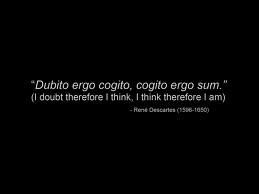
I assume you’ve grasped the role that Descartes’ rigorous doubt has played in laying a solid foundation under the scientific attempt to come to unequivocal certainty about the world as expressed in one of the most famous of philosophical statements: “Cogito ergo sum” (“I think, therefore I am.”). It could have been better translated as “I doubt, therefore I am.” As brilliant as is Descartes’ paradoxical removal of the existence of doubt by doubting everything, it leads us to a more practical and convincing sense of how we perceive what’s around us, moving from whether we exist to what it means to exist. These kinds of questions belong in another branch of philosophy called Epistemology, which answers the question: “How do we know what we know?” which I find a lot more interesting and useful. As Smith writes, “Even if [Descartes’ conclusion] provides firm support for the idea that you exist, it can’t be trusted to bear the weight of your perceptions.” (6) Smith refers to Kant (b. 1804) in the next sentence, but doesn’t elaborate on why Kant matters in this discussion of perceptions, so let me briefly explain. John Locke in 17th-century England had come up with an appealing answer to how we know by suggesting that our brains at birth are like a blank sheet of paper, which he called tabula rasa, which means an “erased tablet” (a second important Latin phrase in philosophy). * On the face of it, Locke’s explanation seems logical and acceptable enough, but Kant didn’t buy it, and for good reason, because it didn’t go far enough. While it appears true that our experiences in life “etch” themselves into our brains through experience, they don’t just sit in there absorbing what’s out there. Certain a priori (a third Latin phrase) conditions (meaning they exist prior to our thinking) also help influence what we perceive, namely, space, time, and causation, which he claimed were three necessary relations. In other words, whatever the empirical laws of nature, they must conform to the necessities of space, time, and causation as we know them.** Therefore, part of what we know is planted in the brain by experience, but the other half of perception is governed by how that experience is altered by those three forces. Thus, perception is a two-way process: receiving sensa (bits of sense experience) into our minds and then our minds imposing a sense of time, space, and causality on what we experience. I find Kant’s contribution an indispensable contribution to the whole question of perception.
This conclusion is a perfect segue to an open-ended question about the relationship of Reality (how we perceive things individually) to Truth (the way things really are universally). Another way to ask this is: “If reality is defined by how we perceive things (and we all perceive things a little differently), how are things really (truthfully, universally)?” Can the two be reconciled or are they by nature different and thus irreconcilable? Just share some of your thoughts on this issue. Remember: no idea is stupid and every thought matters.
*This phrase clearly implies that there was something on the tablet previously to erase, which plays conveniently into the LDS belief in a pre-mortal existence that was “erased” by the Veil of Forgetfulness before we were born into mortality.
**I must add that Einstein’s early 20th-century Theory of Special Relativity (1905), which proved that time and space were interchangeable, rendered Kant’s conclusions false. But for our daily experience, they make sense and still contribute to explaining how we perceive things.
Annie’s Response: (May 10, 2011)
Dad, I liked your use of the word ' trialogue'! So I just finished reading Ch. 1. I'm enjoying this book. I wasn't a big fan of my philosophy class in college, but because of it these names and their ideas are all familiar to me.
Dad, I liked your observations. Your question is very provocative.
“If reality is defined by how we perceive things (and we all perceive things a little differently), how are things really (truthfully, universally)?” Can the two be reconciled or are they by nature different and thus irreconcilable? Just share some of your thoughts on this issue. Jon’s Reaction: (May 14, 2011)
You've written some probing questions. As for defining reality, I've concluded that it's the way things appear to individuals, like seeing through one's own special contact lens without being aware that it's modifying the way things really are out there. I think it's useful to play this definition of reality against the equally provocative definition of truth as the way things really are. Then, as you suggest, the dilemma comes with the question: "How can I see things as they really are?" Or as you ask: "So we need to remove our perceptions and judgments from life to be able to see truth????"
Not really. We just need to link up with a global view of things like God has. I'm reluctant to go there, but if you want a theological answer, which is the only way I know of where we can get out of our limited and distorted ("through a glass darkly") human perspective, I could give you some ideas if you're interested. I'm hoping Tara and Kristin will weigh in on the issue.
At any rate, I'm so glad you're enjoying the book. Smith's a good writer with an original slant on the topics philosophy loves to tackle. But, as I mentioned in my previous email, even philosophers admit that Truth is hard to come by. Plato, in the Seventh Epistle, said something like: "Words are insufficient to bring us to the truth as it really is." So then, I ask myself, what can bring us there? What would you say? His solution was to couch his philosophy in dialogue form and let the reader contribute to the closure. Not a bad idea.
Tara’s reaction:
There is a universal truth although most people aren't aware of it, deny it or pretend it doesn't exist. The reality we inhabit is, I think, comprised of thoughts, past actions, feelings, influences and desires that are either correct and truthful or, for lack of a better term, wack-a-doodle. The 100% of people in that cult who killed themselves were all 100% wrong in their view of reality just like people who are truly enlightened, logical and willing to test faith are, for the most part, living in true reality. I don't think it's a big mystery because of the knowledge I have of the gospel but then, as you wrote, it delves into religion which becomes a sensitive issue for a lot of people.
Kristin’s Reaction:
“Waking Up:” I really loved this chapter. I agree with Annie when I say that I'm really enjoying the book. However, I also really liked the philosophy I was exposed to in college. I remember reading about Descartes, in particularly discussing some ideas as a class. The most influential tidbit I received was on epistemology–the study of what we know and what we don't know. Descartes preferring the truth that we think and thus came the famous line, "I think therefore I am". I remember Dad mentioned once how he received his greatest inspiration when he would wake in the morning. I don't know if this is still true, but maybe that is when we are allowing the bed-fellows of truth and waking to enhance our own understanding of 'truth'. There's still quite a lot I need to digest.
In the Beginning was the Word....(DAD)
“In the Beginning was the Word. . . “
Sunday, August 29, 2010
Dear Green Kids,
A couple of things have happened since returning from China that have given me an idea that could help us become more connected as a family. First, I recently started playing Facebook Scrabble with Annie and Spence. It’s fun, even addictive, and also helps keep my creeping senility at bay, to say nothing of the value of staying in almost constant touch with each other. Second, I’ve read a couple of books recently that have given me a keen interest in continuing education: the first one, Outliers by Malcolm Gladwell, is required reading for Dylan at his new high school, which outlines the conditions that lead to success in life (and they’re not related to IQ); I’m about 1/3 through a second book called The Core by Leigh A. Bortins, a book I wish I’d discovered at the outset of our marriage and family. It is written by a mother who homeschooled her sons and then went on to nationalize her approach to what she calls “classical education,” which involves learning well the ancient trivium (grammar, logic, rhetoric) of the classical seven liberal arts and applying these learning techniques to primary texts in literature, philosophy, and science. If we’d successfully applied some of her principles to our own family over the years, some things might have turned out differently.
These experiences have reminded me that learning and interaction with curious, intelligent people is one of the true pleasures of this life. And since I think we all would agree that open communication was not always one of the fortes of the Green family in the past, we might benefit from expanding our range of interaction into cyberspace and see what happens. So, being somewhat of a cockeyed optimist, I thought to myself: “Why not see if the Green family might be interested in starting a kind of philosophical dialogue among its members on topics timely and topical that could 1) keep our brains from atrophy, 2) learn from and about each other so our affections and connections don’t wane over time, and 3) learn to become more motivated to increase our common knowledge and (and this is one of the greatest assets) to pass on a love of learning about the Good, the True, and the Beautiful to our posterity.
I’d like to invite any of you who are interested to participate in an unscientific experiment by responding to the following philosophical question: “What did Socrates mean when he said: “No evil can happen to a good man?” Sometime this week send back your response to the question and a tentative reaction to the whole idea of creating a forum for discussion based on issues from primary texts we’d read together. We could call it “The Great Conversation” or “The Little Green Schoolhouse,” or something else. It just might set in motion a tradition of on-going communication that could benefit us all down the generations.
Sunday, September 5, 2010
I am grateful to have finished this long letter to the Green Kids early this morning. Here it is. I wanted to keep it all in one place, even though I split the quiz from the opening paragraphs as an attachment.
Dear Green Kids:
I’m elated, even delirious, over your support of my last week’s suggestion that we all share ideas in a “great conversation” by reading some great documents from the past together. It has been gratifying to receive such an unexpected flood of enthusiastic responses, most of them carefully thought through and some eloquently expressed. It gives my old heart a tremendous lift
to find that my own children, unbeknownst to me, have heartily embraced Socrates’ most famous dictum—“The unexamined life is not worth living”—and have ascribed whole-heartedly to his belief that “our primary duty in life is to discourse on the Good, the True and the Beautiful.”
Seriously, in truth no one responded. Actually, one of you sent a one-word reaction. But one word can mean a lot. One of you wrote “Thanks” in response to an earlier email I wrote. That one word made my day! It was so wonderful to discover that I’d made a small difference for good. But I’ve spent the past couple of days trying to decide “What’s it all about, Alfie?”
It’s possible that no one reads my letters to the Green Kids. Even Mom complains that they’re too long. First clue for you: I have a need to interact with my children beyond small talk (think little old lady in rest home who never gets visited—I have a poignant story about that one if you’re ever interested). If you’re just too busy, I’ll understand, really. Just tell me.
It’s also possible that some read my letters but have no interest in responding, which in a way is even more troubling, because one of the “primary duties” of all human beings is to (see above). Socrates’ statement has been the philosophical mantra of my whole personal and professional life. It’s what drove me to become a teacher and what I tried to inculcate in the lives of my children.
Which leads to the third possibility for the deafening silence. It’s a generational thing. I can understand that, because I treated my own patient, incredibly loving father the same way when I was an adolescent. But I can’t accept that explanation here, because you children are hopefully beyond that black hole condition of human development.
So, where do we go from here? To make this short, if not sweet, please take a few minutes to answer the quiz in the attachment. I will tabulate the results and try to act accordingly in the future (Note: Be honest; I can handle it). For the ten-minute version, add a personal note to the questions you find most compelling or most irrelevant.
[Note: I have omitted the quiz and the pages of responses. It makes the introduction too messy.]
Tuesday, September 7, 2010
I woke up this morning with the impression that I should keep a record of the beginning of a new tradition in the Green family, namely, sharing our insights with each other from reading the classics, which I have chosen to call “The Great Conversation.” I will begin including what I have written and what my interested children contribute to this classical conversation in hopes that their children and our grandchildren will someday see that this endeavor is worth more than all the tea in China for its power to keep the wisdom and truth of the past alive in our present lives and to inform the decisions we make in the future. Only second in importance to a firm foundation in religious truth, learning the wisdom of the past in a family setting binds parents to children and gives children the indispensable tools of a classical education (logic, grammar and rhetoric) that will lead to more fulfilling lives and significant service to humanity. What more could parents want for their children? What greater legacy could parents leave them than this?
I will organize the conversation chronologically, as I have already done with my “Gratitude Journal,” beginning with my first letter to the Green Kids from Sunday, September 5, and proceed to add email responses of those willing to participate in the pages that follow. I’m enormously grateful for the encouragement I have been given so far by the only two who have expressed an interest sharing insights about the great ideas of the past. I trust more will come on board as they see the intellectual stimulation it produces. At least that is my hope.
Subscribe to:
Posts (Atom)